Rethinking Extra Dimensions and Consciousness
A Proposal for Physicists:
I am not a physicist or mathematician by training (B.S. Civil Engineering, Lafayette College, 1970), but I wish to offer a fresh perspective on the conceptual challenges posed by string theory’s extra dimensions and their possible connection to consciousness.
In an attempt to grasp this scale, consider that if a string’s proposed length of 10⁻³³ cm were scaled up to 1 cm (about the diameter of a pea), then the pea itself would scale to roughly 10³³ cm, or over 10¹⁵ light-years—more than 10,000 times the diameter of the entire observable universe.
This highlights the extreme minuteness of these strings and implies correspondingly enormous energy scales.
The notion that these extra dimensions behave as one-dimensional strings seems counterintuitive to say the least. Six or more factors that we only can experience as one? What?
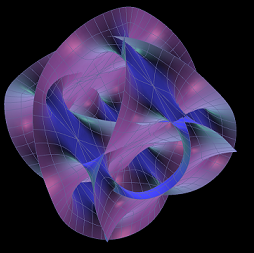
CALABI-YAU 6D MANIFOLD
Historically, science has advanced by embracing radical ideas that initially seemed way outside-the-box: Dirac’s prediction of the positron because the expression for the electron he calculated involved solving a quadratic equation; Pauli’s neutrino hypothesis, which he didn’t announce for years because of its weirdness; and Greenberg’s introduction of a hidden color charge to accommodate quarks and gluons in quantum chromodynamics. Each represented a paradigm shift grounded in mathematical consistency and eventually verified with experimental validation.
Inspired by this tradition, I propose a speculative framework: the extra dimensions posited by string theory may correspond to different levels of experience and cognition, different dimensions of consciousness. Analogous to how color charge is a quantum number completely unrelated to electromagnetic color, these experiential dimensions might have properties analogous to density or other qualitative measures, yet fundamentally distinct from conventional spatial characteristics.

Inspired by this tradition, I propose a speculative framework: the extra dimensions posited by string theory may correspond to different levels of experience and cognition, different dimensions of consciousness. Analogous to how color charge is a quantum number completely unrelated to electromagnetic color, these experiential dimensions might have properties analogous to density or other qualitative measures, yet fundamentally distinct from conventional spatial characteristics.

Stop the shaking. Stop all motion. Stop time. Inspect this tiny slice of spacetime.
Here’s the expression:
xn, yn, zn, tn, s1x, s2x, s3x, s4x, s5x, s6x,
where n is fixed (space and time are locked in) and x is variable.
Spacetime becomes a frozen moment, and in that infinitesimal moment, consciousness is still sloshing around deep within the continuum but outside spacetime strictures. Consciousness is not bound by space or time. There are reciprocal quantum/relativistic effects between space and time and consciousness, of course; but at a given point, consciousness has (at least) six-dimensional freedom. How do you think that “feels?”
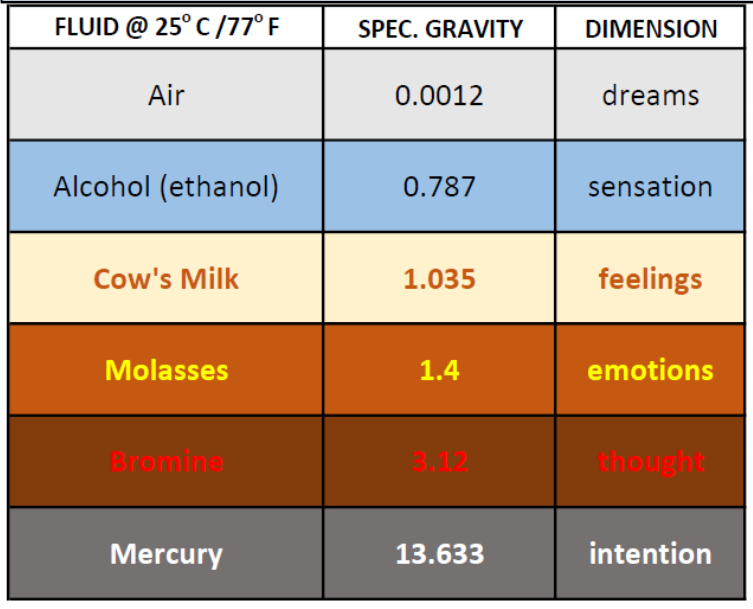
And now at the precise moment of stoppage in our experiment, how would one describe the fluid concoction, the extra dimensional conditions? Well, it’s basically a soup, all six ingredients swirling around, randomly mixing into one frothy brew. But let it settle, with space and time still stuck at position n, and what happens?
The individual constituents begin to separate and settle. The mercury quickly sinks to the bottom. Some of it reacts with the bromine and crystallizes into mercury bromide; the alcohol and milk are miscible; and some bromine sublimates into the air along with alcohol vapors, etc.
Eventually, it settles into a coherent layered structure. When time stops at a given point of space, consciousness settles into a meditative state.
Or not. No one experiences exactly the same reality as anyone else. Radios do not receive waves in the visible light spectrum, though television and radio broadcast frequencies all exist in the same surrounding space. Different receptors, different experiences. The imminent, omnipresent, omniscient, omnipotent God for someone, but nothing like that for others.
That’s what consciousness is like at every moment. When one meditates, time coordinates slow down and allow the string experiences—all six or seven or twenty-two of them—to settle.
This imaginative analysis suggests the possibility that consciousness amounts to everything that goes on in the multiverse that does not fit into current models of quantum/relativistic physics. It is metaphysical reality so-to-speak. So-called subjective stuff. Noetic stuff. Spiritual stuff. Including all our experiences of dreams and of incorporeal entities and our thought and analysis and intention and everything in between, intermingling and becoming our unique sense of self.
It is all a conscious fabric at the Planck scale. Proof of life. Pulsating. We are swimming through it and it is swimming through us; and we are awash within our own bubble of universal mindstuff. Our own singular existence.
And it’s absolutely real; and for each of us completely different. It’s all in the math. Space. Time. Consciousness.
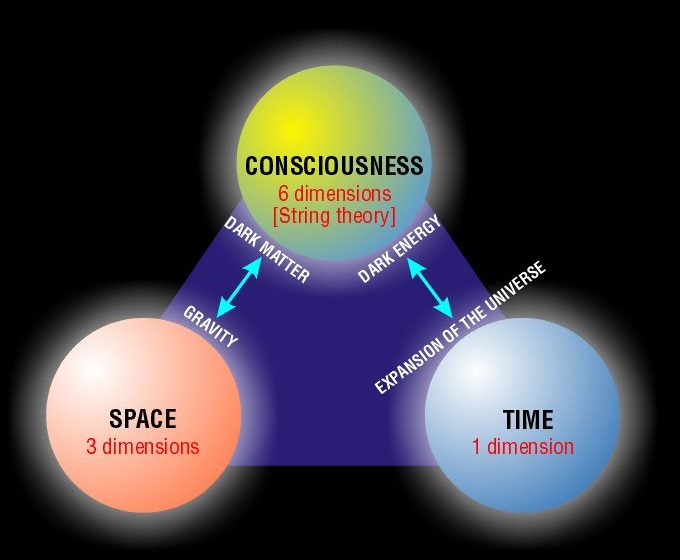
Space is measured in centimeters, miles and lightyears; and time in seconds, years and millenia. If we could define units for these experiential dimensions—perhaps involving a “consciousness constant” analogous to Planck’s constant—we might integrate consciousness as a fundamental aspect of the universe, alongside space and time. Consciousness would not emerge solely from matter but be a foundational substrate, percolating beneath spacetime like virtual particles. And with that, the “hard problem” of consciousness would become moot.
Space is measured in centimeters, miles and lightyears; and time in seconds, years and millenia. If we could define units for these experiential dimensions—perhaps involving a “consciousness constant” analogous to Planck’s constant—we might integrate consciousness as a fundamental aspect of the universe, alongside space and time. Consciousness would not emerge solely from matter but be a foundational substrate, percolating beneath spacetime like virtual particles. And with that, the “hard problem” of consciousness would become moot.

And providing boundless energy in the process.
Amen to the universe.
“The total number of minds in the universe is one.”
Dr. Steven M. Greer

Unless and until we as a species learn to tune in to the universal consciousness, there will always be danger in this world.
Click/tap below to learn about this “DANGER HEY, HEY”.